

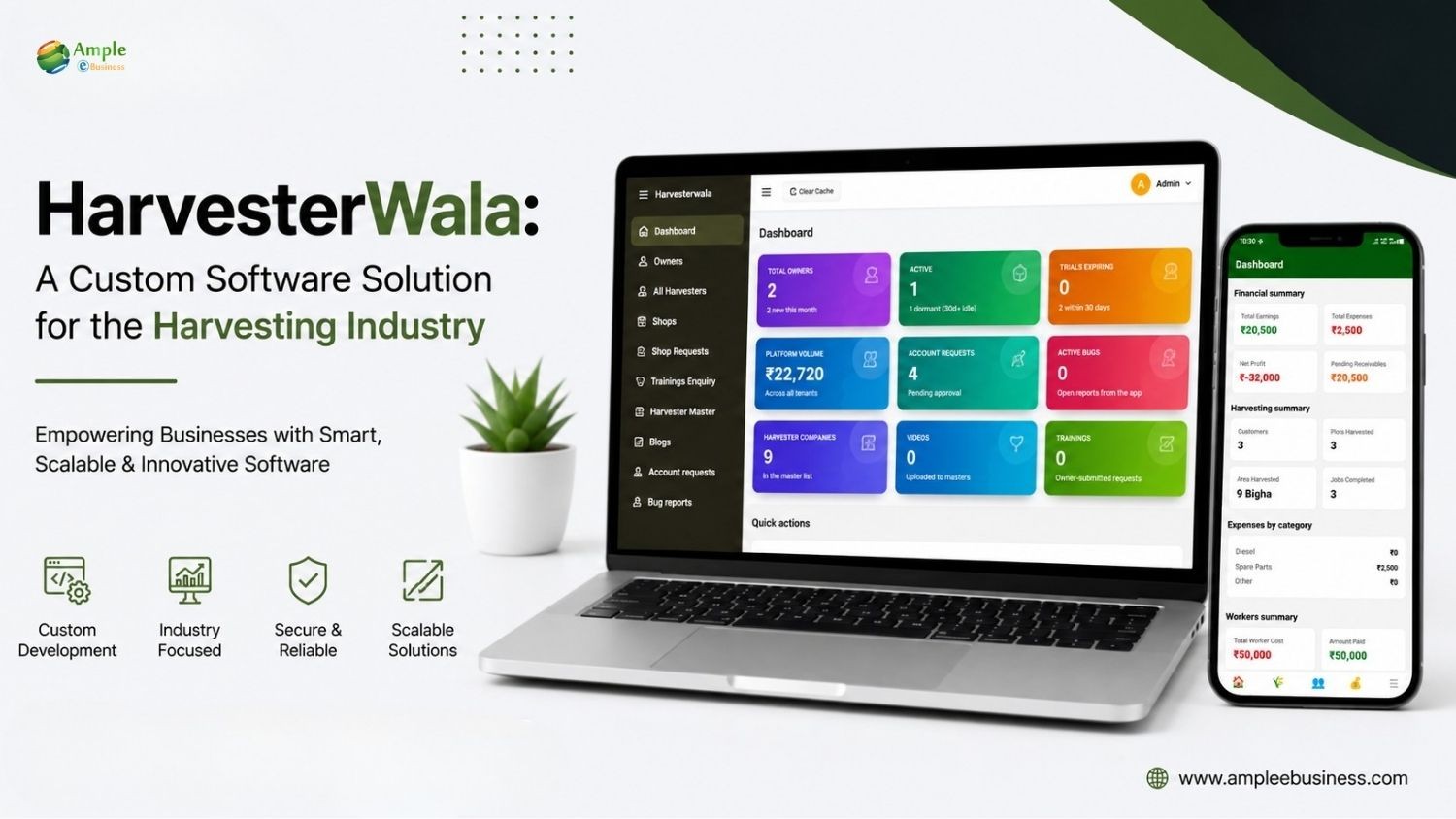
HarvesterWala: A Custom Software Solution for the Harvesting Industry
Aug 24, 2026
The harvesting industry is experiencing rapid change. Starting from managing harvesting activities, customer management, expenses, payments, workers, and machine activities, harvester companies process a huge amount of information during each harvesting season.
However, traditionally, most of this information was processed with the help of such tools as notepads, phone calls, spreadsheet documents, WhatsApp messages, and other disorganised information. This could be enough for several harvesting works but could become quite complicated with the growth of the company.
This is when customized software development for the harvesting industry becomes truly important.
With the help of a specifically developed digital solution, a harvesting company is able to unite all the elements of its activity under one roof. Instead of keeping separate records of job, customer, expense, payment, and workers data, all the processes can be managed using one platform.
HarvesterWala is such a digital solution created for drivers, harvester owners, and contractors.
What Is Harvester Management Software?
Harvester Management Software refers to an electronic tool that enables drivers, harvester owners, contractors, and agricultural service companies to manage the harvesting process from one central source.
Without having to rely on a variety of books or spreadsheets, the software can arrange important business data like the following:
Harvesting orders
Customer information
Field and crop information
Information related to machines
Worker information
Income and payments
Unpaid balances
Diesel and maintenance costs
Costs incurred for spares
Status of work order
Reports about the business
And the goal is straightforward - to convert disparate harvesting data into organized business data. This would be very helpful for the harvesting businesses that have several machines, customers, fields, villages, workers, and job orders.
Why Does the Harvesting Industry Need Custom Software?
Harvester Management Software implies an electronic device which allows farmers, owners of harvesters, contractors, or agricultural service firms to control the harvesting process using one single point.
Instead of depending on a number of books or spreadsheets, the software will organize some business information such as the following:
Ordering to do harvesting
Customers information
Field and crop information
Machine information
Workers information
Income and payments
Outstanding payments
Diesel and maintenance charges
Spares costs
Work order status
Business reports
And the aim is clear; to turn scattered harvesting information into organized business information. It will be highly useful for those harvesting firms which have many machines, customers, fields, villages, workers, and work orders.
HarvesterWala: A Digital Solution Built Around Harvesting Operations
The HarvesterWala software is tailor-made according to the demands of modern-day harvesting ventures.
It functions as a full-fledged Harvest Management Software, bringing harvesting work, clients, costs, payments, employees, and reports all under one roof. The software is meant for farmers, harvester owners, and contractors who seek to simplify their harvesting operations.
Instead of treating harvesting operations as merely tracking machines, the software takes into account the bigger picture of the business as a whole.
This not only encompasses the operations but also the finances involved.
This is crucial to understand because a harvesting venture requires more than just knowing the location of the machines. It requires knowledge of:
What are the scheduled jobs?
Which clients have been served?
What payments are outstanding?
How much diesel cost has been incurred?
What are the maintenance costs?
What are the employee payments?
How much income has been earned?
How is the overall business performing?
Key Features of a Harvester Management App
1. Harvester Booking Management
One of the most important requirements of a harvesting business is managing jobs efficiently.
A harvester booking management system can help users create, organize, update, and monitor harvesting jobs from one place.
Important job information can include:
Customer name
Field or plot details
Village/location
Crop
Harvesting area
Harvesting type
Rate
Booking status
Payment status
HarvesterWala follows a simple workflow where users can add a customer, create a harvesting job, complete the job, record expenses and monitor the resulting business information.
This reduces the dependency on manually searching through notebooks or chat conversations whenever a previous job needs to be checked.
2. Customer Management
Customer information is another important part of harvesting operations.
When a business handles many farmers or landowners, remembering every customer's contact information, field details, job history, and payment status can become difficult.
A digital customer management module can maintain these records in one place.
For example, a customer profile could contain:
Customer name
Contact details
Village
Field information
Previous harvesting jobs
Payment history
Pending amount
This gives the business a more organized view of customer relationships.
HarvesterWala includes customer records along with field details and payment history, helping users keep important information together.
3. Harvesting Business Management
Harvesting Business Management is broader than simply managing machines. It involves coordinating multiple parts of the business at the same time.
A complete digital system can connect:
Jobs + Customers + Workers + Expenses + Payments + Reports
This creates a single source of business information.
For example, when a harvesting job is completed, the business can record the payment received and then associate relevant expenses such as diesel, worker costs, maintenance, or spare parts with the operation.
This creates a more complete picture of the actual economics of the harvesting business.
4. Expense Management
Expenses can have a significant impact on the profitability of a harvesting operation.
Diesel, maintenance, spare parts, transportation, worker payments, and other operating costs can accumulate during the harvesting season.
Without organized records, it can be difficult to understand where money is being spent.
A Harvester Data Management Solution can help categorize and record these expenses digitally.
HarvesterWala, for example, supports recording diesel, maintenance, spare parts, transport, worker costs, and other operating expenses.
This allows business owners to move from simply tracking revenue to understanding income versus operating costs.
5. Payment and Pending Dues Management
One common challenge in service-based agricultural businesses is keeping track of payments.
A harvesting business may have:
Fully paid jobs
Partially paid jobs
Pending payments
Multiple customers with different payment dates
A digital payment management feature can make these records easier to monitor.
Instead of asking, "Who still has to pay?" the business can access a structured record of received and pending payments.
HarvesterWala records payment information against harvesting jobs and provides visibility into pending customer dues.
This can help improve financial control and reduce the chances of forgetting outstanding payments.
6. Worker Management
Harvesting operations often involve workers and machine operators.
Managing worker information manually can become challenging when multiple people are involved across different jobs.
A dedicated worker management module can help businesses organize:
Worker information
Attendance
Job allocation
Wages
Payments
Work-related records
HarvesterWala includes worker management capabilities for organizing worker information, attendance, and payments.
7. Reports and Business Insights
Data becomes valuable when it can be converted into useful information.
A modern Harvester Management Software should not only store data but also help users understand their business performance.
Reports can help answer questions such as:
How many jobs were completed?
How much income was generated?
How much was spent?
How much payment is pending?
Which customers have outstanding dues?
What were the operational expenses?
What was the overall harvesting performance?
HarvesterWala provides reporting functionality to help users monitor harvesting performance and business records.
8. Harvester Tracking Software: Beyond Basic Record Keeping
The future of agricultural technology is moving toward connected and data-driven operations.
This is where Harvester Tracking Software can become an important part of a larger harvesting technology ecosystem.
Tracking capabilities can potentially help businesses understand machine movement, operational activity, job locations, and field-level information.
However, tracking should not be viewed in isolation.
The real value comes when tracking data is connected with business information.
For example:
Machine Location + Job + Customer + Field + Operating Cost + Payment
When these data points are connected, a harvesting business can gain a much broader operational picture.
This is why the evolution from simple tracking tools to integrated Harvester Data Management Solutions can be important for growing agricultural service businesses.
Why Choose an All-in-One Harvest Management Software?
Using separate tools for every business activity can create another problem: fragmented data.
One application may manage customers, another may be used for expenses, while job information may still be stored in a notebook.
An all-in-one Harvest Management Software aims to bring these workflows together.
A centralized system can provide:
Better Organization
All major harvesting records can be maintained in one place.
Less Manual Work
Digital workflows can reduce repetitive record keeping.
Faster Access to Information
Users can find customer, job, payment, and expense information more easily.
Improved Financial Visibility
Income, expenses, and pending payments can be monitored together.
Better Decision Making
Structured data can support more informed business decisions.
Scalability
A software platform can be expanded as the harvesting business grows.
Who Can Benefit from Harvester Management Software?
A specialized harvesting solution can be useful for different types of users.
Harvester Owners
Owners managing one or multiple machines can use software to organize jobs, customers, income, expenses, and payments.
Agricultural Contractors
Contractors handling multiple farmers, machines, workers, and harvesting assignments can benefit from centralized job management.
Agricultural Service Providers
Businesses providing harvesting or related agricultural services can use industry-specific software to organize operational data and improve workflow efficiency.
How HarvesterWala Simplifies the Harvesting Workflow
A major advantage of a purpose-built solution is that the workflow can be kept simple.
HarvesterWala follows a five-step approach:
Step 1: Add Customer
Save the farmer or landowner's basic information.
Step 2: Create Harvesting Job
Add details such as field, area, harvesting type, and rate.
Step 3: Complete the Job
Update the job status and record payment received or pending.
Step 4: Add Expenses
Record expenses such as diesel, spare parts, and worker costs.
Step 5: Track Performance
Use business data and reports to understand income, expenses, and overall performance.
This workflow demonstrates how custom software can turn a traditionally manual process into a structured digital workflow.
Custom Software Development for the Harvesting Industry
HarvesterWala also highlights a larger opportunity for businesses operating in specialized industries.
A custom software solution can be designed around the exact requirements of a business instead of providing a generic set of features.
At Ample eBusiness, custom software development is one of the core technology services, alongside mobile app development, UI/UX design, QA/testing, and digital solutions. The company describes an approach that includes discovery, design and development, testing and deployment, followed by maintenance and support.
For an agricultural technology business, this approach can be used to develop solutions around workflows such as:
Harvest management
Agricultural equipment management
Farm operations
Machine tracking
Field management
Contractor management
Agricultural service booking
Payment management
Business analytics
The important point is that software should be designed around real operational requirements.
What Makes a Good Harvester Management Software?
When evaluating a harvesting software solution, businesses should look beyond the number of features.
A useful solution should be:
Easy to Use
Field operations are fast-moving. Users should not need extensive technical knowledge to manage everyday activities.
Mobile-Friendly
Agricultural operations frequently take place outside a traditional office environment, making mobile accessibility important.
Scalable
The software should be able to support business growth, additional machines, more customers, and increasing job volumes.
Data-Centric
The system should organize business data in a way that makes it useful for reporting and decision-making.
Flexible
Different harvesting businesses may follow different workflows. Customization can make the software more relevant to individual requirements.
Secure
Customer, financial, operational, and business information should be handled with appropriate security practices.
The Future of Harvest Management Software
Agriculture is becoming increasingly data-driven.
As agricultural machinery, mobile technology, GPS, cloud systems, and analytics continue to develop, harvesting businesses can move toward more connected operations.
Future-ready Harvester Management Software may combine:
Job management
Machine tracking
GPS-based location data
Customer management
Digital payments
Expense management
Worker management
Field-level information
Automated reports
Business analytics
The result can be a more connected harvesting ecosystem where operational data and business data work together.
HarvesterWala represents this direction by bringing harvesting jobs, customers, expenses, payments, workers, and reporting into a single digital platform.
HarvesterWala: More Than Just a Harvester Management App
Calling HarvesterWala simply a mobile app would not fully describe its role.
It is better understood as a digital management solution for harvesting businesses.
The platform is designed to simplify the complete business workflow, from adding a customer and creating a harvesting job to recording expenses, managing payments, and reviewing reports.
For harvester owners and contractors, this means business information can be brought into one structured system rather than being distributed across multiple manual records.
For technology businesses, it is also an example of how industry-specific custom software can solve problems that generic applications may not address effectively.
Frequently Asked Questions
What is Harvester Management Software?
Harvester Management Software is a digital solution designed to manage harvesting operations such as jobs, customers, expenses, payments, workers, machine-related records, and business reports from a centralized platform.
What is the purpose of a Harvester Management App?
A Harvester Management App helps farmers, harvester owners, and contractors manage harvesting activities digitally. It can reduce manual record keeping and make important business information easier to access.
What is an all-in-one Harvest Management Software?
An all-in-one Harvest Management Software combines multiple harvesting business functions—such as job management, customer records, expenses, payments, workers, and reports—within one platform.
Who can use HarvesterWala?
HarvesterWala is designed for farmers, harvester owners, contractors, and agricultural service providers who need a simpler way to manage harvesting operations.
Can Harvester Management Software track payments?
Yes. A dedicated harvesting management platform can record payments received and pending dues against jobs and customers. HarvesterWala includes payment and pending-dues management.
Can harvesting expenses be managed digitally?
Yes. A software solution can maintain records of operational expenses such as diesel, maintenance, spare parts, transportation, and worker costs. HarvesterWala provides expense management capabilities for these types of records.
What is Harvester Data Management?
Harvester Data Management refers to organizing and managing the operational and business data generated through harvesting activities, including jobs, customers, fields, payments, expenses, workers, and reports.
Is custom software useful for agricultural businesses?
Yes. Custom software can be particularly useful when a business has specialized workflows that generic software does not handle effectively. It allows features, data structures, and processes to be designed around specific business requirements.
What should I look for in the Best Harvest Management Software?
The Best Harvest Management Software should be easy to use, scalable, mobile-friendly, secure, and capable of managing the core requirements of the business, including jobs, customers, expenses, payments, workers, reporting, and potentially machine tracking.
Final Thoughts
The harvesting industry is no longer limited to machines, fields, and seasonal operations. Like other modern businesses, it increasingly depends on organized information, efficient workflows, and timely decision-making.
A dedicated Harvester Management Software can help transform scattered records into a structured digital system.
HarvesterWala demonstrates how an industry-specific platform can bring harvesting business management, job management, customer records, expenses, payments, workers, and reports together in one solution.
For companies looking to build similar industry-focused digital products, custom software development provides the flexibility to design technology around actual business requirements.
Whether the requirement is a Harvester Management App, Harvester Data Management Solution, Harvesting Business Management System, Harvester Job Management Software, or Harvester Tracking Software, the right technology approach starts with understanding the workflow first and building the software around it.
Interested in building a custom software solution for your industry?
Connect with Ample eBusiness to explore custom software development, mobile application development, and business-focused technology solutions.
To explore the harvesting-specific solution, visit HarvesterWala.


How Scankaaro Software Makes Gym Management Easy
May 16, 2026




What is Scankaaro and How Does It Help Events?
Feb 23, 2026

AI Trends in Web Development for 2026
Jan 16, 2026

Will AI Replace Marketing Teams? The Real Truth
Dec 09, 2025

Address: 312, 3rd Floor, NRK Biz Park, Behind C21 Mall, PU-4, Scheme No. 54, AB Road Indore
+91 7415538151
info@ampleebusiness.com